Physical Address
304 North Cardinal St.
Dorchester Center, MA 02124
Physical Address
304 North Cardinal St.
Dorchester Center, MA 02124

war • strategy • geopolitics
war • strategy • geopolitics
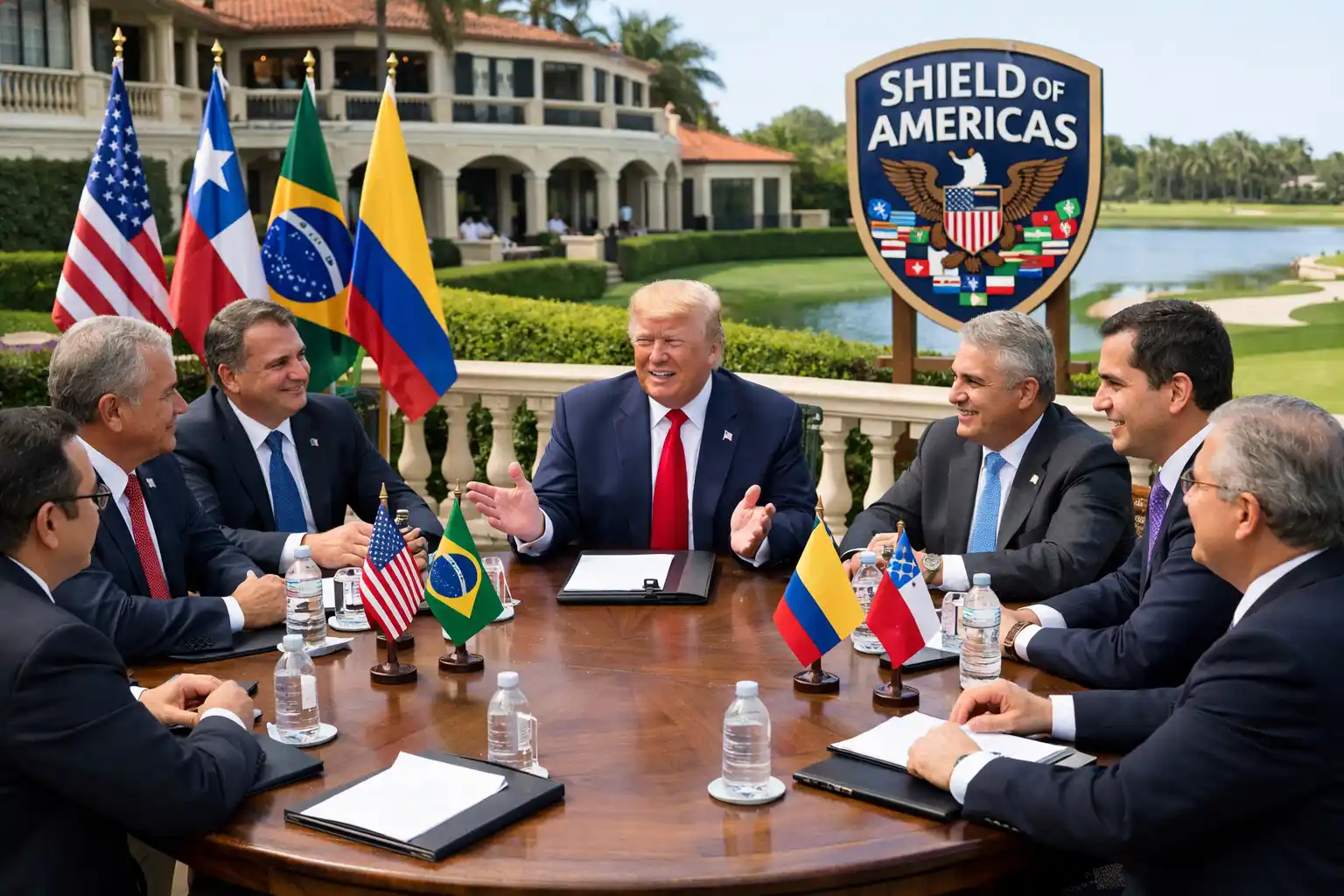
President Donald Trump officially launched the Shield of the Americas alliance today during a high-stakes summit in Miami. He convened twelve conservative Latin American leaders to address regional security threats. This initiative aims to dismantle drug cartels and limit foreign interference in the Western Hemisphere. Consequently, it marks a significant pivot in American foreign policy toward its southern neighbors.
The gathering took place at Trump’s Miami golf club and lasted approximately one hour. Despite the brief duration, the meeting carried a heavy geopolitical weight. White House officials described the pact as a unified front against transnational crime. Moreover, it seeks to modernize military cooperation between participating nations and the United States.
Trump emphasized that Washington is ready to provide unprecedented support to its regional partners. Specifically, he highlighted the potential use of advanced military technology to disrupt criminal networks. This assertive stance indicates a departure from traditional diplomatic norms in the region. It also aligns with the broader US-Iran military conflict Washington strategy 2026 regarding global security dominance.
The primary goal of the Shield of the Americas alliance involves a coordinated crackdown on organized crime. Trump identified drug trafficking and human smuggling as the most immediate threats to hemisphere stability. Accordingly, the alliance will facilitate deeper intelligence sharing among member states. In addition, the US plans to increase training programs for local security forces.
Participants at the summit described the coalition as a “counter-cartel alliance.” Many conservative leaders in attendance expressed frustration with previous regional security efforts. They believe that a more aggressive American presence is necessary for stability. Indeed, Trump promised that US support would be both lethal and precise.
“If you want us to use missiles, they are extremely accurate,” Trump told the leaders. He suggested that military force remains an option for neutralizing cartel leadership. This rhetoric mirrors recent developments where US strikes weaken Iran military capabilities through precision engagements. Such comments have already sparked intense debate among international observers.
Beyond narcotics, the Shield of the Americas alliance targets the growing footprint of external powers. Trump specifically addressed the need to defend Western civilization within the hemisphere. He argued that Latin American nations and the US share a common cultural destiny. Therefore, they must resist influences that threaten these shared values.
White House aides later acknowledged that the initiative counters the expanding reach of Beijing. Over the last decade, China has increased its investments in regional infrastructure and technology. Washington now views these economic ties as a strategic challenge. The new alliance intends to offer a security-centric alternative to Chinese engagement.
Consequently, the pact serves as a modern interpretation of the Monroe Doctrine. This historic policy asserts that external powers should stay out of American hemispheric affairs. Trump’s administration believes that regional security and US national interest are inextricably linked. This philosophy is also reflected in the current US-Iran military conflict legal strategy regarding defensive intervention.
The effectiveness of the Shield of the Americas alliance faces immediate questions due to key absences. While twelve leaders attended, major regional powers like Brazil and Mexico were missing. Mexico remains the most critical partner for US counter-narcotics efforts. However, political friction has complicated the bilateral relationship recently.
Brazil also plays a vital role in South American security and economic trends. Without these two nations, the alliance primarily consists of smaller, right-leaning governments. Some analysts suggest the coalition may lack the necessary scale to dismantle large cartels. Nevertheless, the administration argues that success with smaller partners will attract larger ones.
Furthermore, cocaine production continues to rise in nations like Colombia and Peru. Cooperation with these states is essential for the alliance to achieve its metrics. Trump remains confident that his “America First” approach will yield results where others failed. He suggested that participating nations would receive preferential trade and security treatment.
Expanded military cooperation sits at the heart of the Shield of the Americas alliance. The plan includes the potential deployment of US advisors and advanced surveillance equipment. This technology will help partner nations monitor remote border regions and maritime routes. Consequently, the alliance could transform the technological capabilities of Latin American militaries.
During his remarks, Trump briefly linked regional security to broader global tensions. He mentioned the hostile government in Cuba as a persistent threat. Moreover, he referenced ongoing frictions with Iran as a reason for hemispheric vigilance. This indicates the White House views Latin America as a critical theater in a larger global struggle.
The administration’s focus on military strength is a consistent theme across all regions. This is evident in their handling of the Trump-Iran leadership transition and Middle East defense. By strengthening the southern flank, Washington aims to free up resources for other global flashpoints. The Shield of the Americas alliance is the cornerstone of this defensive perimeter.
Critics of the summit noted that the event followed a strictly controlled format. Latin American leaders were largely invited to listen to Trump’s vision. Public dialogue was limited, and no joint press conference followed the meeting. This has led to concerns that the alliance may be too US-centric.
However, supporters argue that clear American leadership is exactly what the region requires. They believe that decentralized efforts have allowed cartels to flourish for years. A unified command structure under the Shield of the Americas alliance could disrupt these networks. Ultimately, the success of the initiative depends on consistent funding and political will.
As the program evolves, the world will watch the impact on migration and drug flows. If successful, Trump may use this model for security pacts in other regions. For now, the focus remains on securing the Western Hemisphere against all threats. Interested readers can find more on regional military shifts in our report on Iranian Kurdish groups ground operations.