Physical Address
304 North Cardinal St.
Dorchester Center, MA 02124
Physical Address
304 North Cardinal St.
Dorchester Center, MA 02124

war • strategy • geopolitics
war • strategy • geopolitics
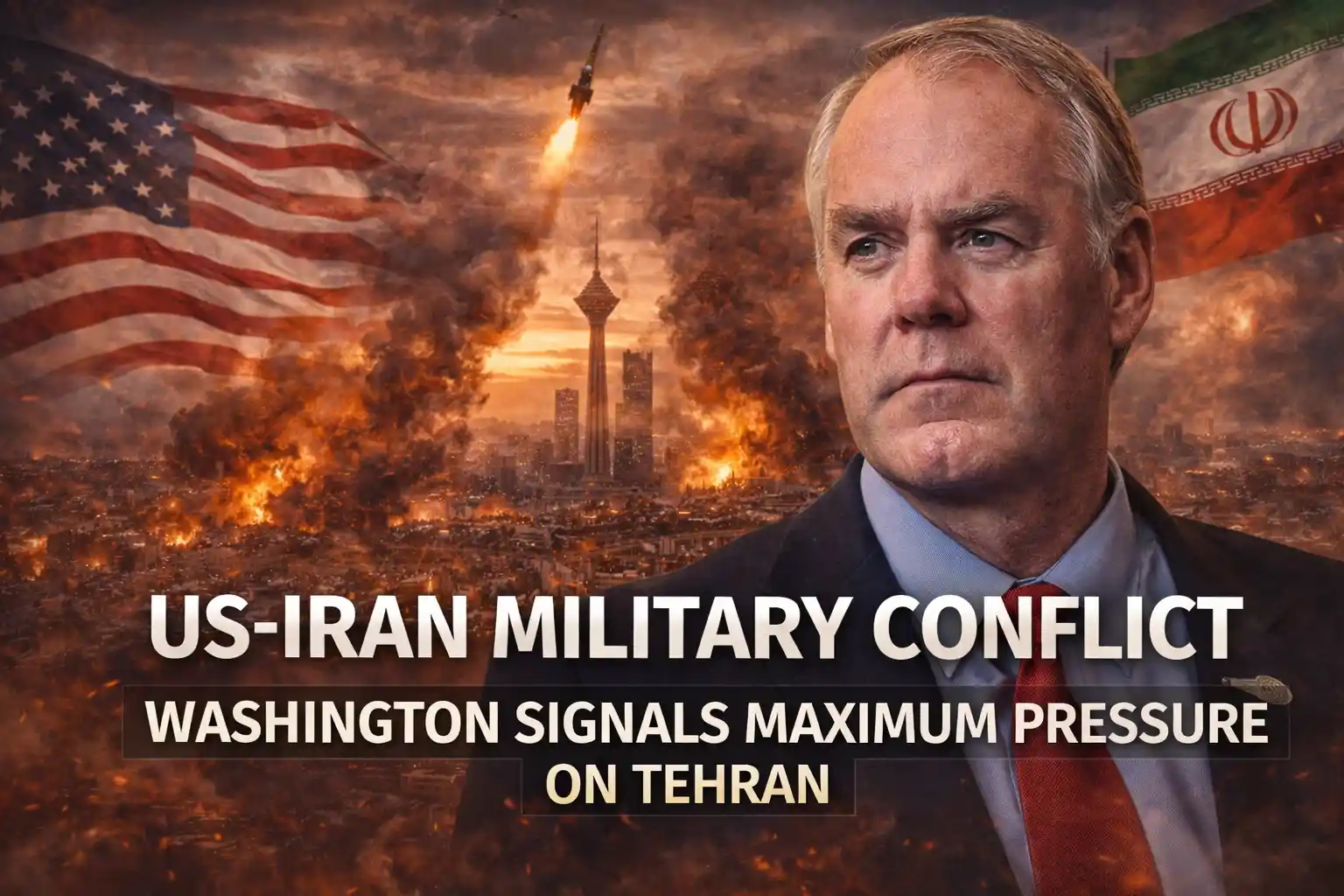
The US Iran military conflict has entered a critical phase, forcing Washington to confront profound legal and strategic uncertainties. As military operations intensify across the Middle East, a fierce debate has emerged regarding the boundaries of presidential authority. Furthermore, policymakers are struggling to define the long-term objectives of this direct confrontation.
During a recent high-level briefing, former defense official Mick Mulroy analyzed the complex legal landscape governing Washington’s actions. He emphasized that the current situation tests the delicate balance between executive power and congressional oversight. Consequently, the international community is closely monitoring how these legal definitions will shape the next stage of the US Iran military conflict.
A central point of contention is whether the US Iran military conflict meets the constitutional definition of a war. Under the United States Constitution, the authority to declare war resides exclusively with Congress. However, the President may initiate military action during an “imminent threat” to national security.
Early intelligence reports suggested that Tehran was accelerating its long-range missile programs. Nevertheless, later assessments indicated that such technology remains years away from operational deployment. Therefore, many lawmakers now question if the initial strikes met the strict legal threshold for an emergency response.
Speaker Mike Johnson recently argued that the United States is not technically at war. This distinction is vital for political flexibility. Under the War Powers Resolution, the administration can conduct limited operations for 60 days without a formal declaration. By avoiding the term “war,” Washington maintains its strategic momentum while bypassing immediate legislative roadblocks.
The ongoing US Iran military conflict has also sparked intense speculation regarding a possible ground invasion. However, military experts warn that such an operation would require unprecedented resources. For instance, the 2003 invasion of Iraq utilized roughly 150,000 troops, yet Iran presents a much larger geographic and demographic challenge.
Iran’s terrain is rugged and its population is significantly larger than that of Iraq. Consequently, a full-scale invasion would necessitate a massive military buildup across regional bases. Such preparations would be impossible to hide from global surveillance. For this reason, most analysts believe that Washington will continue to rely on air and naval power rather than committing large ground forces.
Furthermore, domestic political support for a new Middle East war remains low. Both major parties in Washington are cautious after decades of costly interventions. The administration clearly prefers a strategy of “maximum pressure” without the high human and financial costs of a ground war. This approach aims to weaken Tehran’s influence while avoiding a total regional collapse.
Civilian casualties have become a sensitive flashpoint in the US Iran military conflict. Recent reports indicated that a school in southern Iran was struck during a nightly air operation. According to local claims, the strike resulted in significant loss of life among students and staff. Major outlets like The New York Times and Reuters have launched investigations into the origin of this tragic incident.
Military analysts stress that modern rules of engagement are designed to minimize collateral damage. However, mistakes in intelligence or mechanical failures can lead to devastating consequences. Therefore, conducting a transparent investigation is essential for Washington to maintain its international credibility. If evidence confirms an errant strike, it could significantly alter the public’s perception of the US Iran military conflict.
The conflict is not isolated; it deeply involves regional actors like Israel and Lebanon. Recent airstrikes in Beirut have increased fears that the US Iran military conflict will transform into a broader regional conflagration. While Washington provides strategic support, it cannot easily dictate Israel’s independent military decisions.
In the past, the United States encouraged de-escalation through diplomatic channels. However, priorities have shifted since the current crisis began. Currently, Washington is focused on containing Tehran’s proxy networks, such as Hezbollah and Hamas. You can read more about these regional dynamics in our analysis of the Trump Iran Leadership Transition.
This shift has made regional stability efforts increasingly complex. Lebanon has urged Washington to restrain Israeli operations, but strategic independence remains a core tenet of the US-Israel alliance. Consequently, the risk of miscalculation remains high as multiple nations pursue overlapping security objectives in a crowded battlespace.
Technologically, the US Iran military conflict has demonstrated the rapid evolution of modern warfare. The initial phase of the campaign relied on expensive, high-precision standoff missiles. These weapons were used to dismantle Iran’s sophisticated air defense networks. Once “air superiority” was achieved, the tactical approach shifted significantly.
With the skies now controlled by allied forces, pilots can utilize more cost-effective munitions, such as GPS-guided gravity bombs. This transition allows the military to conserve its most advanced technology for potential future threats. According to defense analysts, this tiered strategy is a hallmark of modern air campaigns.
The ultimate trajectory of the US Iran military conflict remains highly unpredictable. While legal debates continue in Washington, military realities on the ground are evolving daily. Policymakers must now balance their strategic goals with growing domestic pressure and international scrutiny.
For the moment, the United States appears committed to maintaining military pressure without escalating into a full-scale war. However, the path toward de-escalation is fraught with political obstacles. Decisions made in Washington and Tehran in the coming months will determine the future of Middle East security for the next generation.

[…] may be more complex than initially expected. This uncertainty adds a layer of risk to the ongoing US-Iran military conflict legal strategy being debated in […]
[…] This secretive nature often fuels rumors about internal power struggles. Nevertheless, the constitutional mandate remains the primary guide for the transition. For a deeper look at the legal hurdles involved in these transitions, read our report on the US-Iran military conflict legal strategy. […]
[…] to prevent further bloodshed. This call for intervention is particularly urgent given the US-Iran military conflict legal strategy currently being debated in global […]